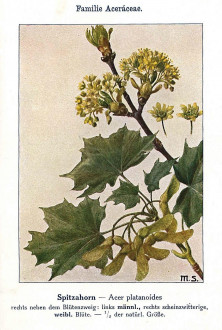
Species: Acer platanoides L., Genus: Acer, Family: Sapindaceae, Group: Angiosperms

(Acer platanoides L.)
-> Genus: Acer -> Family: Sapindaceae -> Group: Angiosperms

Habitus

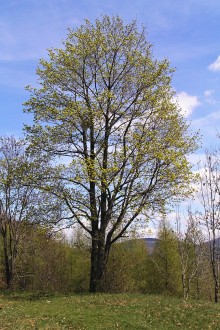
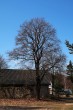
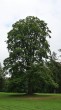
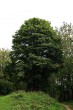
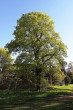
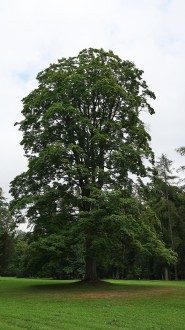
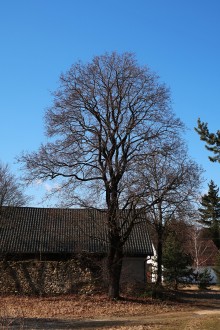
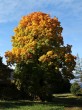
  • it grows to a height of 20 - 30 m, crown is ovoid to broadly ovate, densely leafy
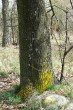
  • bark is reddish-brown to brown, later greyish
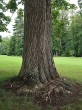
  • bork is dark grey, shallowly fissured into narrower rectangular roof-like raised formations, relatively firm

Buds

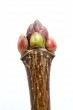
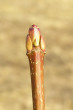
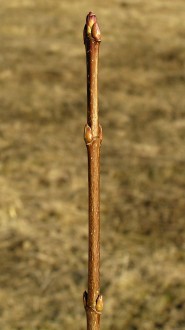
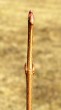
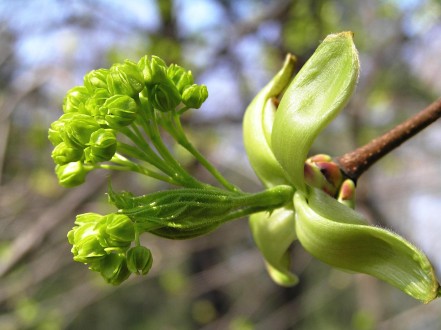
  • buds are arranged crosswise, they are ovate, sessile
  • terminal one is larger lateral ones are smaller, pressed to the twig !
  • covering scales are oval, brownish-red, glabrous, shiny

Shoots

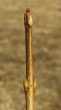
  • shoots are straight, olive green, later reddish brown,  glabrous, shiny
  • leaf scars touch each other

Leaves (assimilation organs)

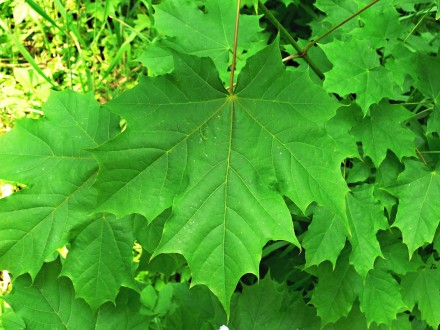
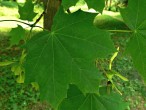
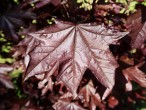
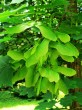
  • the leaves are simple, palmately 5 - 7 lobed, 8 - 12 x 9 - 12 cm large
  • the individual lobes have several sharp pointed protrusions
  • the notches in the leaf blade are rounded !
  • the leaves are with entire margin
  • the petiole is 4 - 15 cm long, when broken off it exudes a white sticky sap

Flowers

  • it is a monosexual tree with bisexual flowers
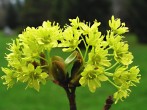
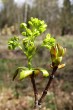
  • it flowers in April - before the leaves develop, or simultaneously
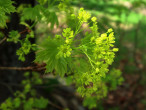
  • flowers are yellow-green, grouped in upright panicles

Fruits – seeds

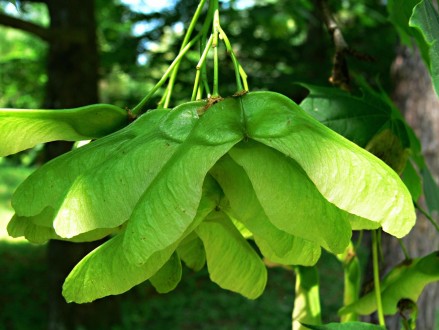
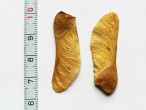
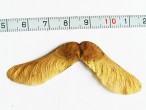
  • the fruit is a winged dicotyledon fused at an obtuse angle !
  • the wings are green to reddish, brown when ripe, 4 - 6 cm long, equally wide along the entire length
  • the seeds are flat
  • the germination rate is 50 - 80% and it begins to bear fruit between 20 - 30 years
  • seedling:
    • the cotyledons are ligulate with one midrib and two parallel veins on both sides, they are widened towards the end, slightly folded across
    • the first leaves are petiolate, ovate-cordate, slightly pointed, weakly lobed, the leaf margin is slightly toothed

Extension

  • ± all of Europe except the British Isles and Western Europe
  • in Slovakia it occurs from the lowest altitudes to an average of 1,000 (1,464) m above the sea level
  • it is an interspersed – individually mixed tree species in oak and beech forests
  • it grows on ridges, scree and in valleys together with sycamore (Acer pseudoplatanus), European ash (Fraxinus excelsior), species of the genus elm (Ulmus) and lime (Tilia)
  • it belongs to the so-called valuable broadleaves

Ecology

  • it is a semi-shaded tree, frost-resistant, it is relatively demanding on nutrients (but less than the mountain maple), mainly on nitrogen
  • it requires a certain soil moisture
  • it is part of the hard liquor
  • it also tolerates urban environments well
  • the root system is round

Significance

  • it is valuable broadleaf tree
  • it is a reclamation and groundcover tree, protects the soil and improves it with its fallow
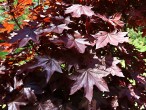
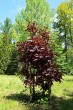
  • it is a park tree that creates many shapes (spherical form) as well as colored leaf forms (shear-leaved, red-leaved, variegated - with a yellow edge)
  • the wood is coreless, yellowish-white, heavy, hard, shiny, high-quality
  • the wood is used to make violins

From history

Support atlasdrevin.sk

Súbory cookies:

S cieľom zabezpečiť riadne fungovanie tejto webovej lokality ukladáme niekedy na vašom zariadení malé dátové súbory, tzv. cookie.
Ak povolíte všetky cookies a navštívite nás nabudúce, pripojíte sa vďaka ním rýchlejšie, a náš web vám ponúkne relevantné informácie a umožní vám počas objednávky jednoduchšie vyplniť vaše údaje. Súbory cookies používame najmä na anonymnú analýzu návštevnosti a vylepšovania našich stránok. Ak sa rozhodnete neakceptovať cookies, nebudete môcť používať niektoré funkcie na našej webovej stránke.

Akceptovať všetky cookies